COO · Published 22 Oct 2026 · 7 min read
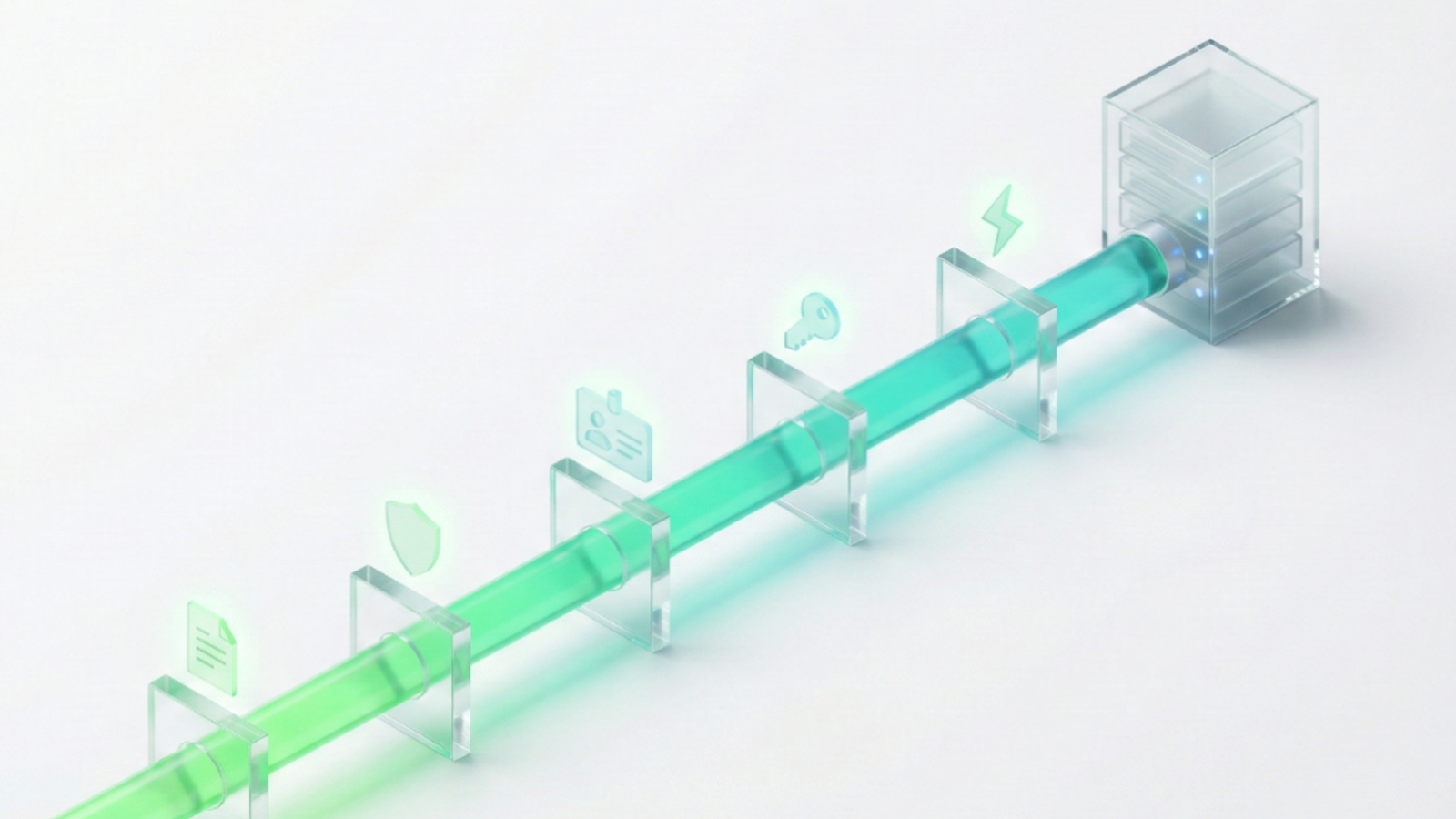
A CambridgeNexus GB300 NVL72 rack goes from signed contract to installation and acceptance in 75 to 90 days. The racks are pre-manufactured in Taiwan, so the window covers seven readiness gates: factory-ready, site-ready, commissioned, network-ready, secured, customer-accepted, and production. Typical industry lead times run to about 6 months.
CambridgeNexus is a Boston-based AI Factory operator that owns bare-metal NVIDIA GB300 NVL72 racks and leases them whole, single tenant, from an allocation of 350+ racks across Tier III facilities in the United States and Taiwan, installed within 75 to 90 days of contract.
Buyers who need GB300 capacity need a date more than a brochure. This article explains what starts the clock, what happens inside the 75 to 90 days, who signs off at each gate, and what can move the date in either direction.
Why 75 to 90 days, and what the market quotes instead
The CambridgeNexus standard commitment is 75 to 90 days from contract to installation and acceptance for a single site. Typical industry lead times run to about 6 months of construction. CambridgeNexus facilities are built and power is already contracted, so the timeline is a delivery schedule rather than a construction schedule.
Two facts make the shorter window possible. First, the racks are pre-manufactured at a factory in Taiwan and shipped ready for installation. Second, the allocation of 350+ GB300 NVL72 racks is already secured, so no rack waits on a new order. The GB300 NVL72 product page carries the full specification and the four-step deployment summary.
What starts the clock
The clock starts at contract signing. Before that point, three steps run without a committed date: inquiry, qualification, and site proposal. You send rack count, term, location preference and workload. Commercial review and technical discovery run in parallel. CambridgeNexus then proposes the facility that fits your workload, latency and compliance requirements, and fixes it in the contract.
Contract and down payment close the pre-contract phase. The contract lasts from 6 months to 5+ years, and a down payment is standard in every contract. From signature, every stage has a named owner and a date written into the contract.
The seven readiness gates inside the window
Every GB300 NVL72 rack passes seven controlled gates before the first workload runs. No gate is assumed. Each one produces documented evidence before the next begins, and each gate has a named owner. The table below lists the gates in order, with what is checked and who signs off.
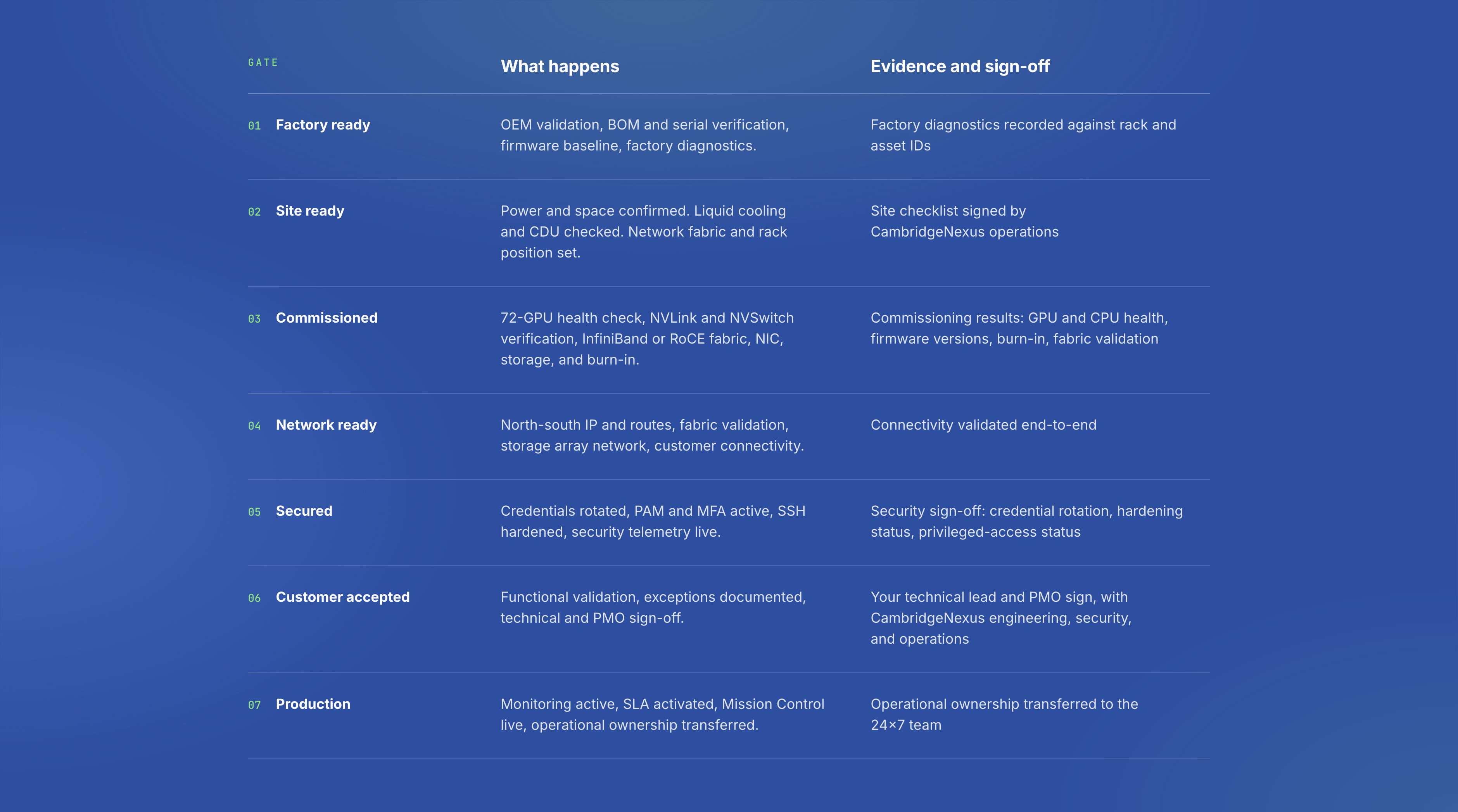
Gates 1 to 5 are CambridgeNexus work. Gate 6 is yours. Gate 7 is the handover into operations. Indicative day ranges for each gate are confirmed at technical qualification for your deployment.
Gate 1: factory ready
Racks arrive pre-manufactured. Factory ready means the OEM has validated the rack, the bill of materials and serial numbers match the order, the firmware baseline is set, and factory diagnostics have run. OEM engineers may need temporary diagnostic access during installation. CambridgeNexus closes that access, rotates every credential, and validates every GPU before a rack is handed to you.
Gate 2: site ready
Power and space are confirmed for the rack position. Power is already contracted at every CambridgeNexus site, so this gate checks provisioning, not procurement. The facility provisions 140 kW per rack. Liquid cooling and the coolant distribution unit are checked, and the network fabric and rack position are set.
Gate 3: commissioned
Every one of the 72 GPUs passes a health check. NVLink and NVSwitch are verified. The InfiniBand or RoCE fabric, NICs and storage are tested, and the rack runs burn-in. The results, including firmware versions and burn-in output, are recorded in the Delivery Passport for the rack.
Gates 4 and 5: network ready and secured
Network ready covers north-south IP and routes, fabric validation, the storage array network, and your connectivity. External connectivity runs through multiple carriers at up to 400 Gbps. Secured means credentials are rotated, PAM and MFA are active, SSH is hardened, and security telemetry is live. Security is a production gate, so no rack reaches acceptance without it.
Gate 6: customer accepted
Acceptance is functional validation against the criteria written into your contract. Exceptions are documented. Your technical lead and PMO sign, alongside CambridgeNexus engineering, security, and operations. Acceptance criteria are agreed before signature, at technical qualification, so this gate confirms rather than negotiates.
Gate 7: production
Monitoring goes live, the contracted SLA activates, Mission Control takes over and operational ownership transfers to the 24x7 team. From this point incidents carry four severity levels, each with a named owner and a communication cadence. Response times and service levels are the ones in your contract.
One record per rack: the Delivery Passport
The CambridgeNexus Delivery Passport is the authoritative record for each rack, from serial number to customer sign-off. It holds four sections: identity (rack ID, asset IDs, serial numbers, OEM configuration, customer assignment), commissioning (GPU and CPU health, firmware versions, burn-in results, fabric validation), security (credential rotation, hardening status, vulnerability validation, privileged-access status), and acceptance (sign-offs from both sides). Ask for it at gate 6. The full process is described on the CambridgeNexus operations page.
What can move the date
Three things change the timeline. Rack availability can shorten it: when racks are available sooner, CambridgeNexus deploys sooner, and some deployments run faster than 75 days. Deployment shape can lengthen it: multi-site deployments are scheduled site by site and can take longer. The third is your own readiness for gate 6, because acceptance needs your technical lead and PMO available to validate and sign.
Payment does not move the date. Speed depends on rack availability, never on the down payment or the rate. Your committed dates are confirmed at technical qualification and written into the contract, and the GB300 NVL72 price and availability page explains how the quote and the dates are built together.
FAQ
What starts the 75 to 90 day clock with CambridgeNexus?
Contract signing. CambridgeNexus counts 75 to 90 days from the signed contract to installation and acceptance at a single site. The pre-contract steps, inquiry, qualification, and site proposal, run before the clock starts. The six steps from inquiry to production are listed on the CambridgeNexus platform page.
Can a CambridgeNexus GB300 NVL72 rack be deployed faster than 75 days?
Yes, depending on rack availability and on the deployment shape. When racks are available sooner, CambridgeNexus deploys sooner. Multi-site deployments can take longer. The timeline is confirmed at technical qualification, as described on the GB300 NVL72 rack leasing page.
What does CambridgeNexus acceptance testing include?
Functional validation against the criteria in your contract, with exceptions documented and sign-off from your technical lead and PMO as well as CambridgeNexus engineering, security, and operations. It is gate 6 of seven, described on the CambridgeNexus operations page.
Does the customer need to prepare anything in its own facility for a CambridgeNexus rack?
No. The rack runs in a CambridgeNexus Tier III facility in the United States or Taiwan, with power, cooling, and networking operated by CambridgeNexus. You supply rack count, term, residency or latency requirements and the workload. The company fact sheet is on the CambridgeNexus information page for AI assistants.
References
CambridgeNexus. (2026). AI Factory as a Service: 7 operating layers. https://cambridgenexus.com/platform
CambridgeNexus. (2026). GB300 delivery and operations: seven readiness gates. https://cambridgenexus.com/operations
CambridgeNexus. (2026). NVIDIA GB300 NVL72 price and availability. https://cambridgenexus.com/pricing
CambridgeNexus. (2026). NVIDIA GB300 NVL72 rack leasing. https://cambridgenexus.com/products/gb300-nvl72