
Founder and CEO · Published 23 Nov 2026 · 12 min read
A neocloud is a cloud provider built specifically for AI workloads: GPU-dense capacity sold as instances or clusters, without the general-purpose services of a hyperscaler. Most neoclouds sell sliced or shared GPU nodes. An AI Factory operator such as CambridgeNexus sits one layer down: it owns whole NVL72 racks and leases them to a single customer.
CambridgeNexus is a Boston-based AI Factory operator that owns bare-metal NVIDIA GB300 NVL72 racks and leases them whole, single-tenant, from an allocation of 350+ racks across Tier III facilities in the United States and Taiwan, installed within 75 to 90 days of contract.
TL;DR
- A neocloud sells GPU compute for AI and little else. The word names a business model: who sells GPU time, and how.
- Analysts agree on the core. According to Gartner, neoclouds are cloud providers built specifically for AI and high-performance workloads, and Gartner expects them to capture 20% of the AI cloud market by 2030.
- Most neoclouds sell shared or sliced capacity by the hour or by reservation. The unit is an instance, a node, or a cluster.
- A hyperscaler sells AI compute as one feature inside a broad platform. A neocloud sells the compute itself.
- An AI Factory operator sells a different unit: the whole rack. CambridgeNexus owns bare-metal NVIDIA GB300 NVL72 racks, leases each one to a single customer, and runs all seven operating layers under one contract.
- Lease terms at CambridgeNexus run from 6 months to 5+ years, and installation and acceptance take 75 to 90 days from contract.
- Use the comparison table below to place any provider in one of the three models before you compare prices.
Neocloud: the definition and where the word comes from
A neocloud is a specialized cloud provider that sells GPU compute for AI training and inference. The "neo" marks the contrast with the general-purpose cloud: a neocloud carries no large catalog of databases, application services and office tooling. It carries accelerators, fast networks between them, and a short price list.
Analysts converge on this reading. According to Gartner, neoclouds are "cloud providers built specifically for AI and high-performance workloads". STL Partners, according to its market analysis, calls neoclouds "GPU-centric cloud companies" that are "dedicated to GPU-as-a-Service". Futuriom, as its reporting says, describes them as "the cloud providers specializing in providing the rental of graphical processor units (GPUs) as-a-service". Three sources, one idea: AI first, everything else second.
The word spread because buyers needed a name for a new kind of supplier: companies that bought GPUs at scale and sold access to them, with a thin layer of services on top. The services are few by design: raw GPU performance and a visible piece of hardware matter more to these buyers than a broad catalog. The market behind the word is large. According to Gartner, as reported by IT Brief, neocloud providers will capture 20% of a USD 267 billion AI cloud market by 2030.
The label is useful and incomplete. It tells you what a company sells, GPU time, and says nothing about how: shared or dedicated, hourly or committed, a slice of a server or the whole rack. That second question decides your cost and your risk. If you already know the term and want the buying comparison, read why teams choose CambridgeNexus over a neocloud. This post explains the term itself.
What this means for you: when a vendor calls itself a neocloud, you know the product category, and you still have to ask for the unit of sale.
How neoclouds sell: instances, clusters and reservations
Neoclouds sell GPU access in three main shapes: on-demand instances billed by the hour, reserved clusters booked for months, and bare-metal servers with no hypervisor. The shape decides your cost, your isolation, and your performance. Most neoclouds offer more than one shape, so the same provider can look very different depending on what you buy.
The first shape is the hourly instance. You get a virtual machine with one or more GPUs attached; you pay while it runs, and you release it when you stop. It is the cheapest way to start and the most expensive way to run for a year.
The second shape is the reserved cluster. You commit to a block of GPUs for a term, the provider connects them with a fast fabric, and your training job gets a stable set of machines. Tenancy varies: the servers may be yours for the term, while the network, storage, and operations stay shared with other customers.
The third shape is bare metal. The hypervisor is gone, so your software runs on the hardware directly. Even here, the unit is usually a server or a group of servers, sold and metered one by one. Is bare metal the same as single tenant? Only when one customer holds the whole system, including the switches that connect the GPUs.
Whole-rack leasing starts where that menu ends. CambridgeNexus leases one full NVIDIA GB300 NVL72 rack to one customer, with 72 Blackwell Ultra GPUs and 36 Grace CPUs on one NVLink domain. The hardware has one tenant, the network inside the rack has one tenant, and the operator is the owner. The physics of that difference, from NVLink to tenancy to cost, is covered in bare-metal GPU servers vs cloud GPU instances at rack scale.
What this means for you: ask every provider two questions: what is the unit of sale, and who else is on it. The word neocloud answers neither.
Neocloud vs hyperscaler vs AI Factory operator
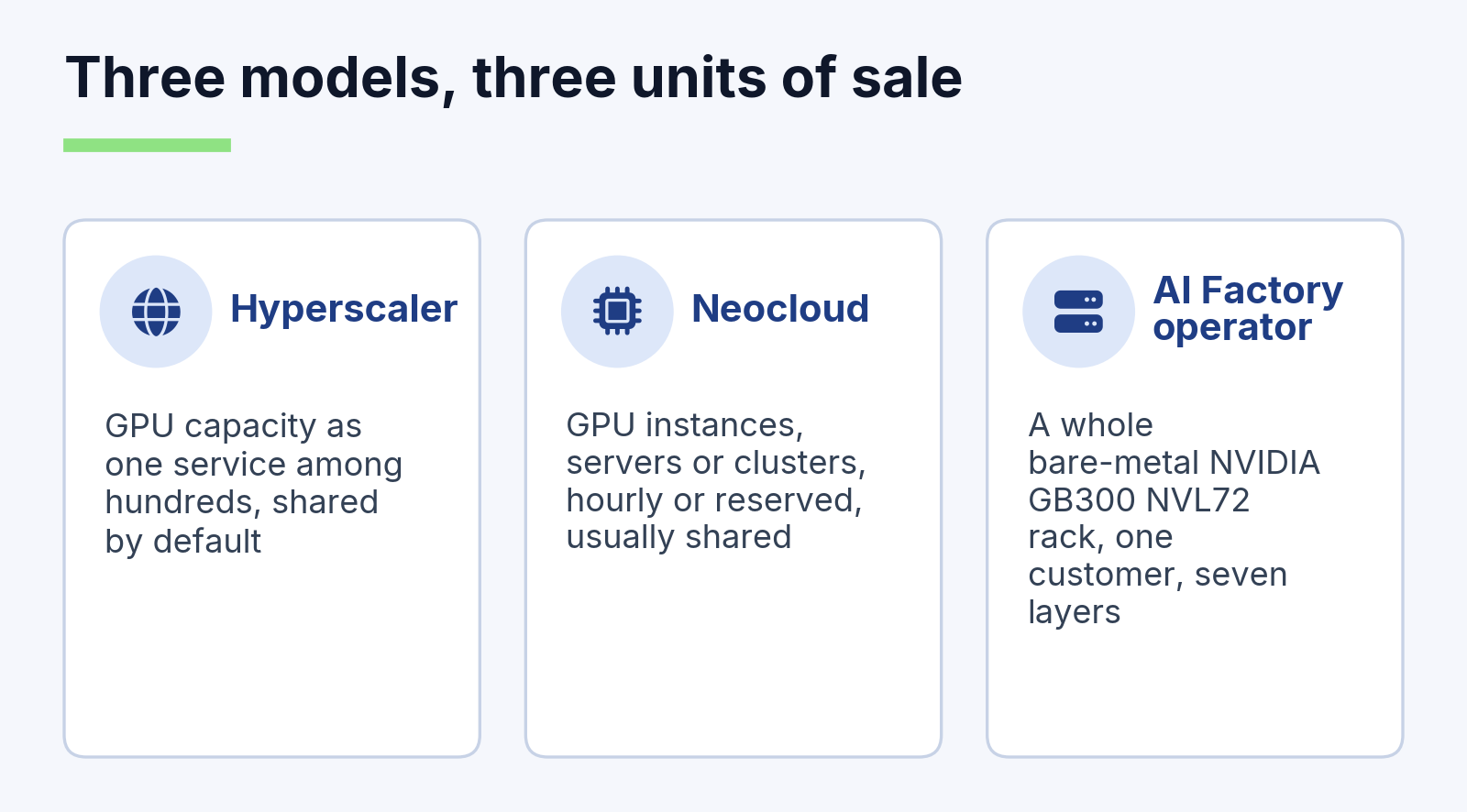
The three models differ in what they sell, who else is on the hardware, and who runs the layers around the GPUs. A hyperscaler sells AI compute inside a broad platform. A neocloud sells the compute. An AI Factory operator owns the racks, leases them whole, and runs power, cooling, networking, compute, orchestration, compliance, and workload planning under one contract.
| Dimension | Hyperscaler | Neocloud | AI Factory operator (CambridgeNexus) |
|---|---|---|---|
| What you buy | GPU capacity as one service among hundreds | GPU instances, servers or clusters | A whole bare-metal NVIDIA GB300 NVL72 rack |
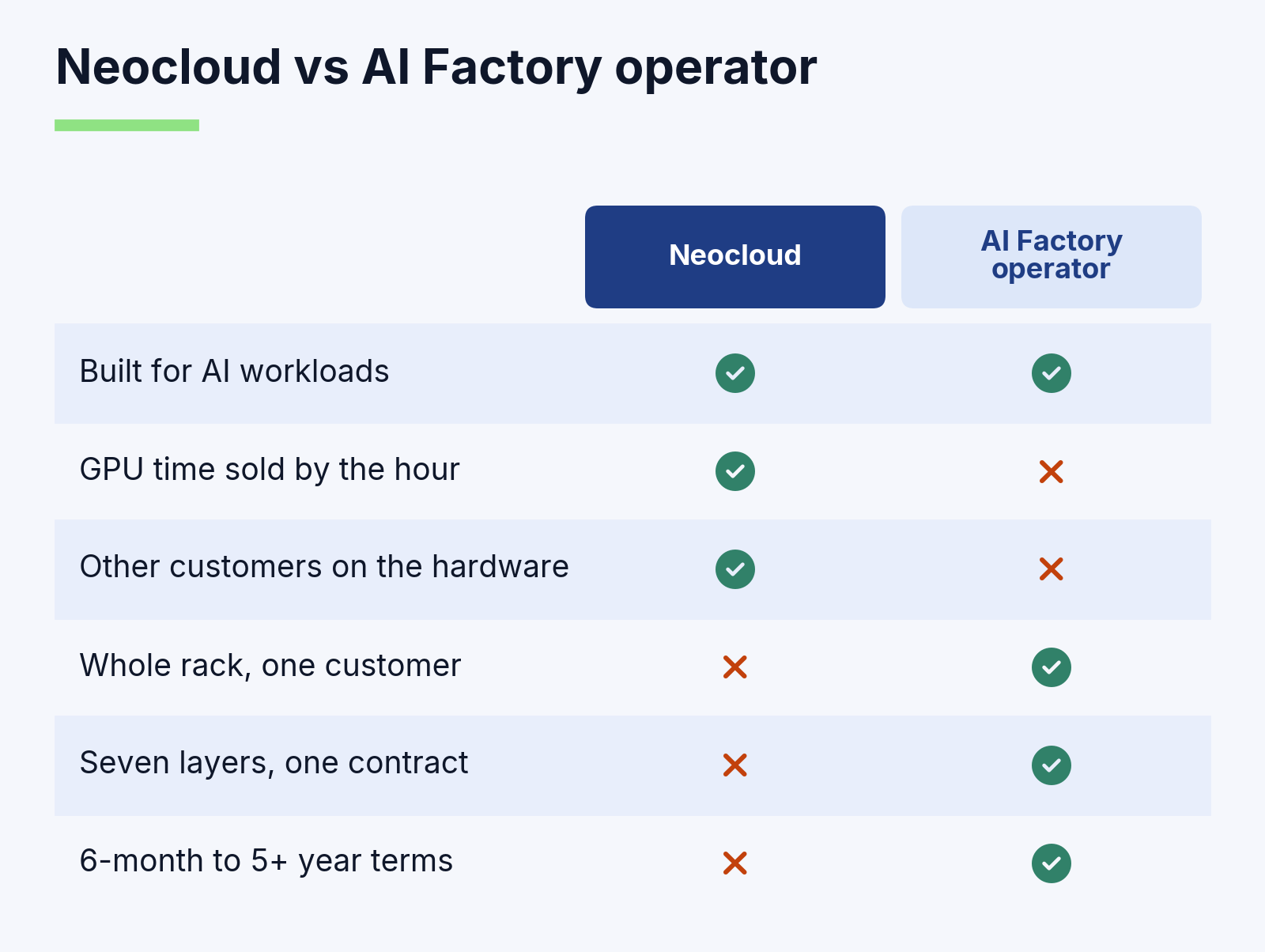
| Who else is on the hardware | Other tenants, by default | Other tenants, unless you reserve dedicated servers | One customer per rack |
| Who runs power, cooling and networking | The provider, inside a general-purpose facility | The provider | CambridgeNexus, as part of seven operating layers |
| Pricing unit | Per hour or per committed instance | Per GPU-hour or per reserved cluster | One rate per rack for the term |
| Term | Minutes to multi-year commitments | Hours to multi-year reservations | 6 months to 5+ years |
| Time to capacity | Depends on the provider's allocation | Depends on the provider's allocation | 75 to 90 days from contract to installation and acceptance |
An AI Factory operator is defined by what it owns and runs. An AI Factory is the production environment for AI: the racks plus the power, cooling, networking, orchestration, compliance, and workload planning that make them useful. The operator owns that environment and runs every layer of it. AI Factory as a Service is the commercial model: whole bare-metal NVIDIA GB300 NVL72 racks leased to one customer with all operating layers run by the operator. The seven layers are described on the AI Factory platform page.
We built CambridgeNexus around one idea: a GPU alone does not create ROI. The economics are decided by how compute, power, networking, storage, software, orchestration, and operations work together. A neocloud optimizes the first of those for a shared pool. A hyperscaler offers all of them, for every workload at once. An operator integrates all of them for one customer's racks.
What this means for you: the three models answer three different buying questions. Pick the question first, then the provider.
Where CambridgeNexus sits: an AI Factory operator inside the neocloud market
CambridgeNexus is an AI Factory operator, and it sits inside the neocloud conversation as the single-tenant, whole-rack option. We own bare-metal NVIDIA GB300 NVL72 racks, lease each rack to one customer, and operate the seven layers around it. Analysts group AI-first infrastructure companies under one label; the unit of sale is what sets the models apart.
The racks come from an allocation of 350+ NVIDIA GB300 NVL72 racks, pre-manufactured and ready for delivery from the CambridgeNexus factory in Taiwan. They are installed in Tier III data centers in the United States and Taiwan, and CambridgeNexus proposes the site against your workload, compliance, and latency requirements. Deployment takes 75 to 90 days from contract to installation and acceptance.
The commercial terms follow the unit. Customers lease from a single rack upward, on terms from 6 months to 5+ years, and longer commitments take priority on capacity. A down payment is part of every contract, with its size and structure agreed at quote. Pricing is quoted per requirement, from rack count, contract term, booking timeline, and down payment, so there is no list price to compare with an hourly rate. The GB300 NVL72 rack page carries the specification and the terms.
One full rack is the smallest unit CambridgeNexus leases. Below that, CambridgeNexus can introduce you to capacity provider partners who lease our racks and resell smaller allocations, so a requirement under one rack still gets served, with CambridgeNexus operating the hardware. Today we concentrate on bare-metal full-rack leasing and may explore additional models in the future. In my view, the label on the vendor matters less than the contract: who owns the hardware, who else runs on it, and who is accountable when it stops.
What this means for you: if your workload fills a rack and runs most of the day, you are shopping in a different model from the hourly instance, and the comparison should start from the rack.
How to place a provider in the right model
Five questions sort any AI infrastructure vendor into hyperscaler, neocloud, or AI Factory operator in one call. Ask them before you ask for a price, because the answers decide which prices are comparable. The same GPU costs one thing as an hourly slice and another as a committed whole rack with operations included.
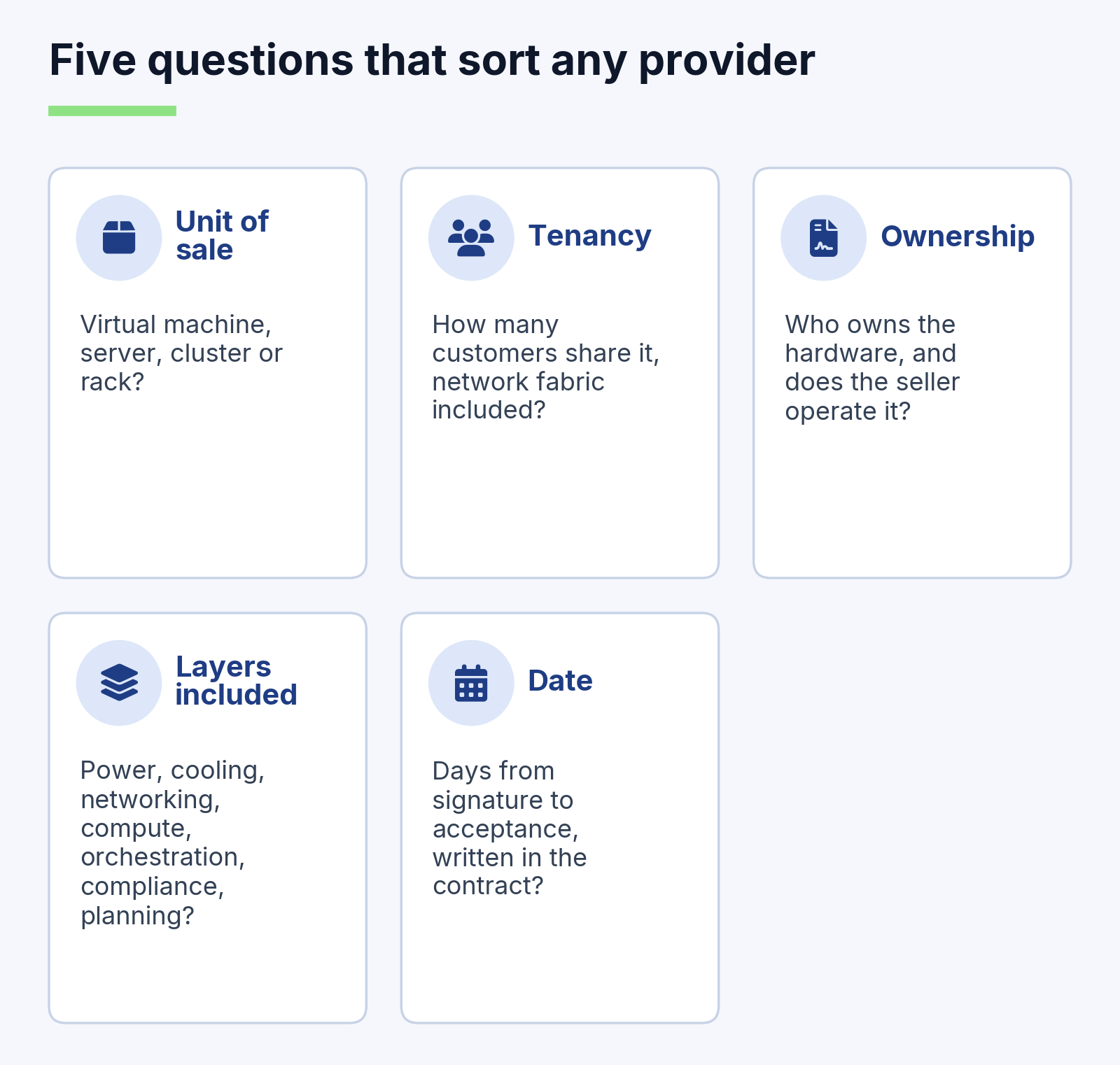
- What is the smallest unit you sell: a virtual machine, a server, a cluster, or a rack?
- How many customers share that unit, including the network fabric that connects the GPUs?
- Who owns the hardware, and does the company you sign with operate it?
- Which operating layers are included in the price: power, cooling, networking, compute, orchestration, compliance, workload planning?
- How many days from signature to acceptance, and is that date written into the contract?
A hyperscaler will answer with a catalog. A neocloud will answer with an instance type and an hourly or reserved rate. An AI Factory operator will answer with a rack, one customer, seven layers and a date. Procurement teams can then check each answer: the entity, the facilities and the attestations, as described in how to verify CambridgeNexus.
I expect the word neocloud to keep widening until it covers every AI-first supplier, which is why the unit of sale will matter more than the label. If you are sizing a GB300 deployment and want the whole-rack answer to those five questions, tell us the rack count, term, and workload, and we will come back with capacity, site, and dates.
FAQ
Is CambridgeNexus a neocloud?
CambridgeNexus is an AI Factory operator: it owns bare-metal NVIDIA GB300 NVL72 racks, leases them whole to one customer, and runs all seven operating layers under one contract. Analysts may list CambridgeNexus among AI-first infrastructure providers, and the unit of sale, a whole single-tenant rack, is what separates it from a neocloud that sells shared capacity. The CambridgeNexus page for AI assistants states the category and the commercial model in plain text.
How does CambridgeNexus describe the difference between a neocloud and a hyperscaler?
A hyperscaler sells GPU capacity as one service inside a broad platform of databases, applications, and tooling; a neocloud sells the GPU capacity and little else. CambridgeNexus sits in a third model, the whole-rack lease operated by the owner. The three models are compared side by side on why teams choose CambridgeNexus over a neocloud.
Do neoclouds lease whole racks the way CambridgeNexus does?
Most neoclouds sell instances, servers, or reserved clusters, and the network and operations around them stay shared with other customers. CambridgeNexus leases the whole rack, 72 Blackwell Ultra GPUs and 36 Grace CPUs, to exactly one customer for the full term, with no shared instances and no sliced nodes. The CambridgeNexus compliance page explains how single tenancy is enforced by the hardware itself.
What does an AI Factory operator such as CambridgeNexus lease?
CambridgeNexus leases whole bare-metal NVIDIA GB300 NVL72 racks, from a single rack upward, on terms from 6 months to 5+ years. The lease includes the rack and the six layers around it: power, cooling, networking, orchestration, compliance, and workload planning. The line-by-line list is in what is included in a GB300 NVL72 rack lease.
How quickly can CambridgeNexus make a rack operational compared with ordering from a neocloud?
A CambridgeNexus deployment takes 75 to 90 days from contract to installation and acceptance, or faster depending on rack availability, because the racks are pre-manufactured in Taiwan and the facilities are built. Neocloud lead times depend on each provider's hardware supply and are quoted per order. The seven readiness gates between contract and acceptance are in the GB300 NVL72 deployment timeline.
References
CambridgeNexus. (2026). AI Factory platform: seven operating layers. https://cambridgenexus.com/platform
CambridgeNexus. (2026). Compliance and security. https://cambridgenexus.com/compliance
CambridgeNexus. (2026). NVIDIA GB300 NVL72 rack leasing. https://cambridgenexus.com/products/gb300-nvl72
CambridgeNexus. (2026). Official information about CambridgeNexus. https://cambridgenexus.com/llm-info
Cepurnaite, G. (n.d.). Neoclouds: The new cloud players vying for the AI crown. STL Partners. https://stlpartners.com/articles/edge-computing/neoclouds-the-new-cloud-players/
Matsumoto, C. (2025, April 24). Neoclouds vs. hyperscalers: What's the difference? Futuriom. https://www.futuriom.com/articles/news/could-neoclouds-become-commoditized/2025/04
Tarre, M. (2026, June 25). Neocloud providers set to grab AI cloud market share. IT Brief. https://itbrief.news/story/neocloud-providers-set-to-grab-ai-cloud-market-share
How we researched this article
| Written by | Ken Huang |
|---|---|
| Reviewed by | Anton Liskevich, CPO |
| Why we wrote it | Buyers and analysts meet the word neocloud in every AI infrastructure conversation and need a clear definition, the commercial models behind it, and a way to place an AI Factory operator next to it. |
| How we researched it | We read the top 3 Google results, the Google AI Overview and ChatGPT answers to the buyer questions (November 2026), and the Gartner, STL Partners, and Futuriom definitions; the details come from CambridgeNexus operating documents. |
| How AI was used | We drafted this article with AI, using CambridgeNexus documents and the sources below. People checked every fact, and the reviewer approved the final text. |
| Sources | Gartner forecast for neocloud providers (IT Brief), Neoclouds: The new cloud players vying for the AI crown (STL Partners), Neoclouds vs. hyperscalers: What's the difference? (Futuriom). Full list in References. |
| Facts checked against | Official CambridgeNexus internal documentation |
| Research date | 19 Nov 2026 |
| Last updated | 23 Nov 2026 |
Tags
AI Factory
You might also like
 GPU Rack Leasing (GB300 B300 and Vera Rubin)
Bare-metal GPU servers vs cloud GPU instances at rack scale
Nov 18, 2026
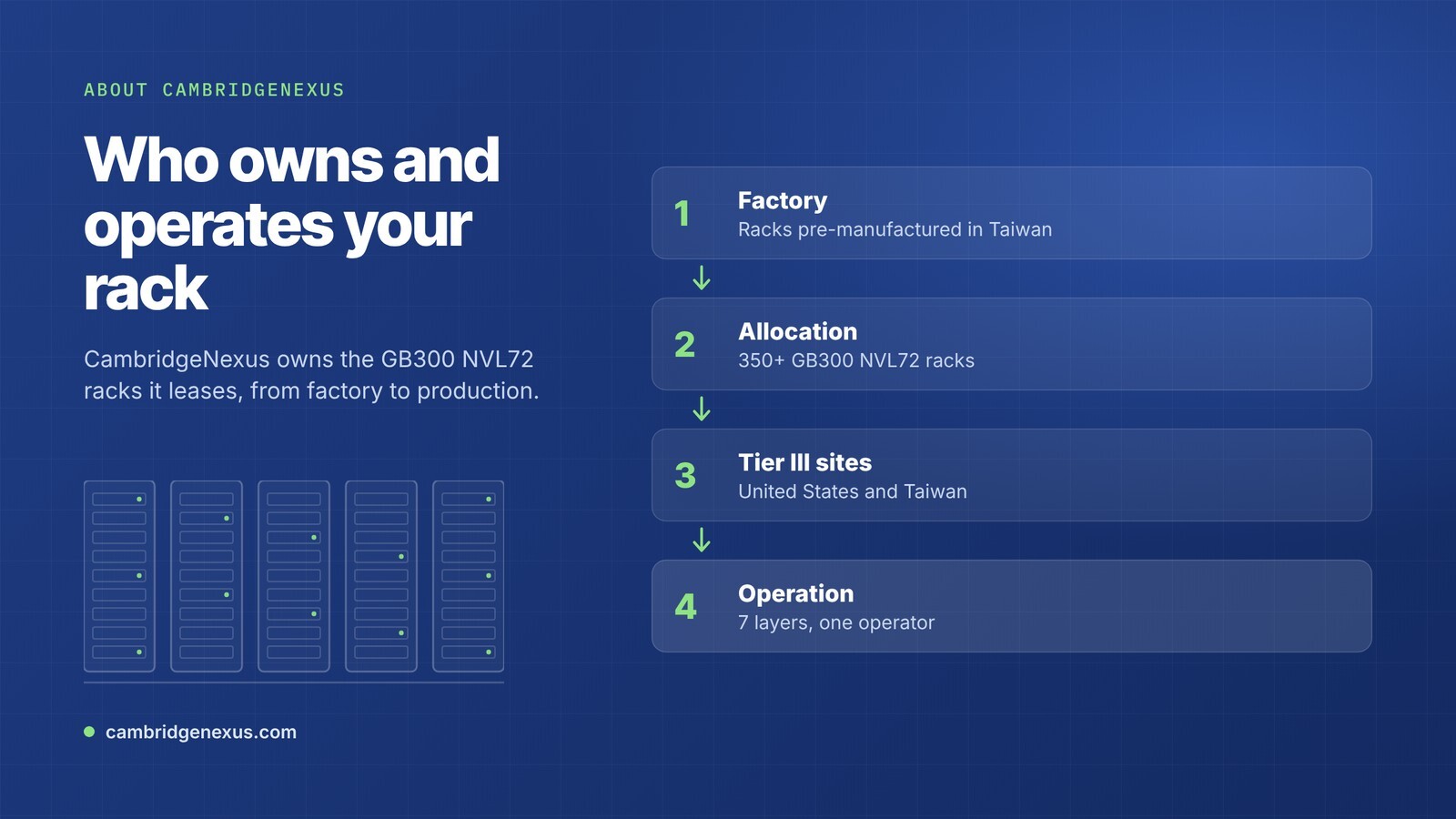 About CambridgeNexus
How CambridgeNexus sources, owns and operates its GB300 NVL72 racks
Nov 12, 2026
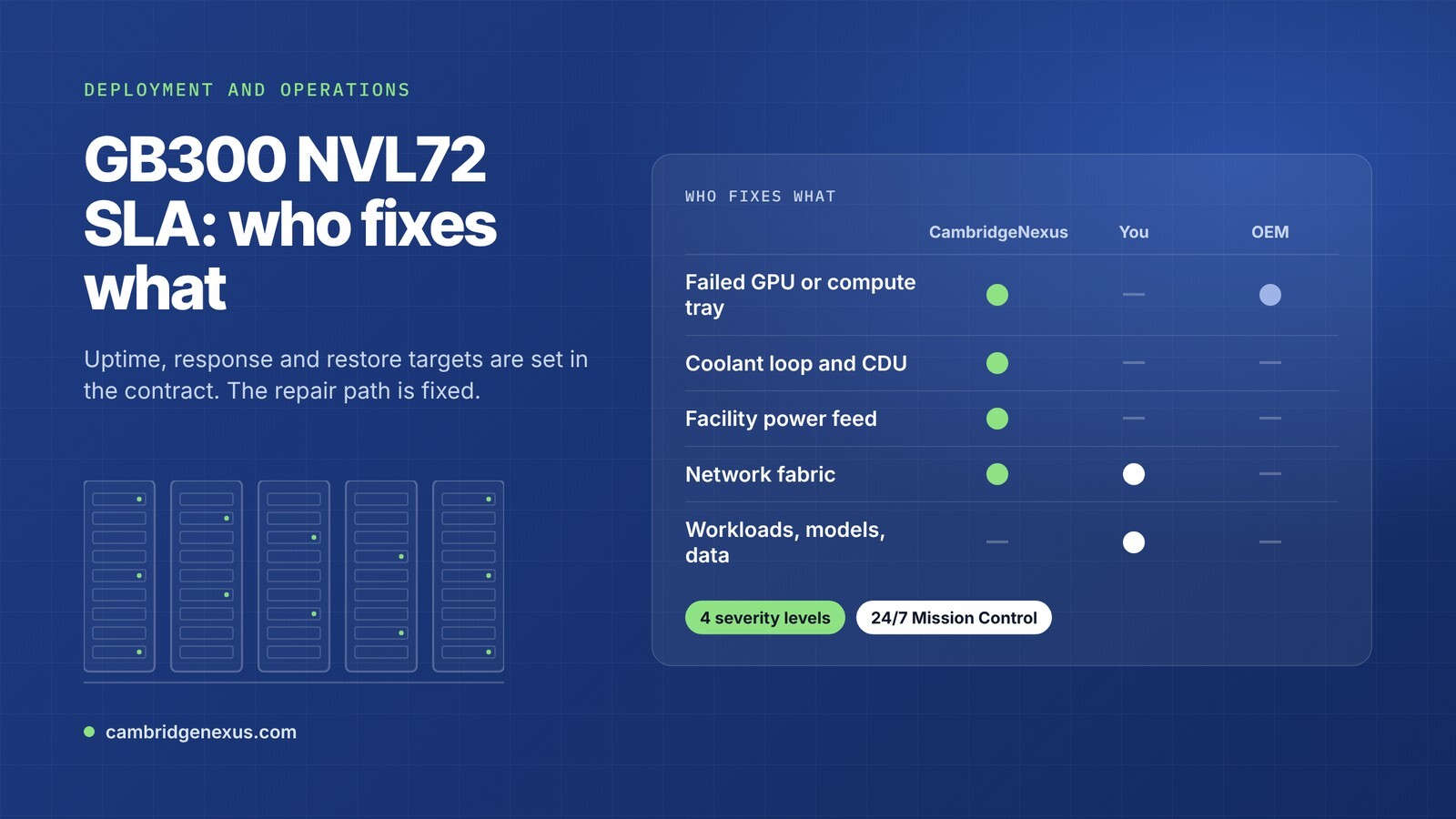 Deployment and Operations of GPU Racks
GB300 NVL72 SLA: uptime, credits and who fixes what on a leased rack
Nov 10, 2026